1st Phorm · Product Record

1st Phorm Project-1 Pro

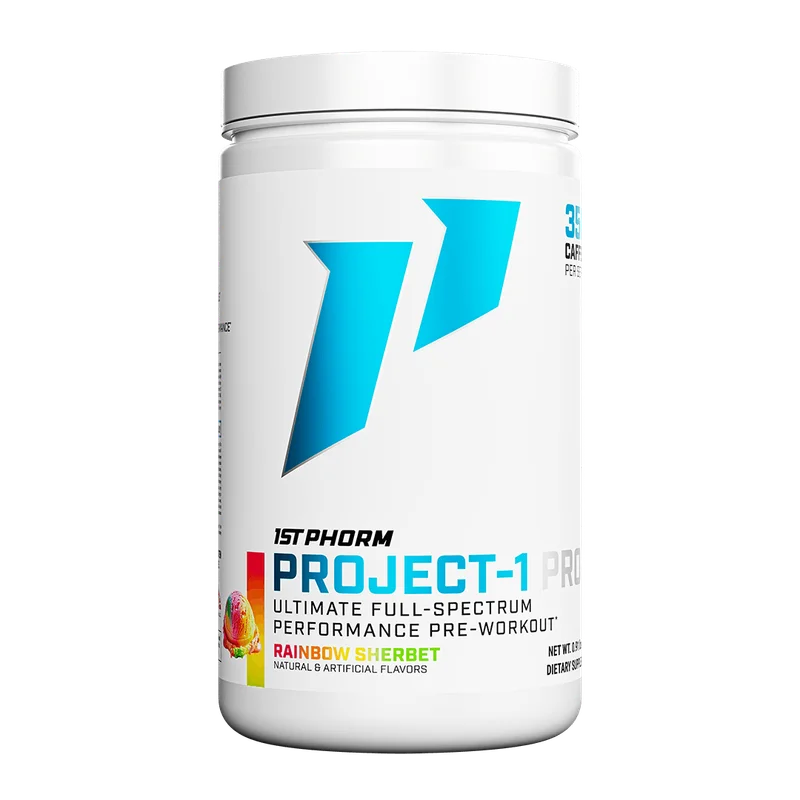
1st Phorm Project-1 Pro, front of package
CURRENTLabel dated September 26, 2026Source last checked October 12, 2026Latest capture October 4, 2026Pre-workout

THE SHORT ANSWER

1st Phorm Project-1 Pro declares caffeine from 1 declared source (Caffeine Anhydrous 350 mg), with no total published by FormulaSignal on the label FormulaSignal observed September 26, 2026. All 14 of its declared ingredient lines carry an amount. It costs $2.85 a serving (observed price, basis not established on Sep 26, 2026).

1st Phorm Project-1 Pro has a current Record. Latest source capture October 4, 2026. The current public formula contains 14 declared ingredient lines. Comparable formula history is not yet available.

Save to my LockerWhere to buy Keep a dated label reference free. Monitoring is optional.

Source checks scheduled every week

Last valid reading Oct 12, 2026.

Recent check activity
  1. No change detected in this reading
  2. No change detected in this reading

Activity belongs to the Record. It is not evidence of checks performed for your account before you started watching. Source checks do not establish the contents of your tub.

FRESH CHECK

Buying again soon? Send this product to the front of the line and we’ll check the brand’s page again.

What a fresh check covers

Requests bring a source check forward. They do not scan your tub, guarantee a result, or start a subscription. Requests for the same product share a monitoring pass. Allowances reset monthly in UTC; guest allowances are shared by people on the same connection.

Current Record

The current declared formula.

Printed label wording stays separate from FormulaSignal's normalized identity. Current formula observed September 26, 2026.

Serving size
Not recorded
Servings
Not recorded
Caffeine
Not computable from current evidence
Formula scope
FLAVOR SPECIFIC
1st Phorm Project-1 Pro, current declared formula observed September 26, 2026. Each row gives the printed label wording, the declared amount, and FormulaSignal's normalized identity.
Original label wordingDeclared amountNormalized identity
Sodium (as Pink Himalayan Salt)200 mgsodium as pink himalayan salt
L-Citrulline6 gl-citrulline
Creatine Monohydrate5 gcreatine monohydrate
Beta Alanine3.2 gbeta-alanine
Taurine1 gtaurine
L-Theanine400 mgl-theanine
Caffeine Anhydrous350 mgcaffeine
Alpha GPC 50% (L-a-Glycerylphosphorylcholine)300 mgalpha-gpc 50% material
VasoDrive-AP® (Hydrolyzed Casein)254 mgvasodrive-ap hydrolyzed casein
PhytO2™ (Acerola Juice Concentrate, Grape Seed Extract, Strawberry, Green Coffee Bean Extract, Green Tea Extract, Maltodextrin, Maqui, Acai, Turmeric Extract, Silica, Kale, Tart Cherry, Broccoli, Blueberry, Citric Acid)190 mgphyto2 acerola juice concentrate grape seed extract strawberry green coffee bean extract green tea extract maltodextrin maqui acai turmeric extract silica kale tart cherry broccoli blueberry citric acid
ElevATP® (Ancient Peat Extract, Apple Extract)150 mgelevatp ancient peat extract apple extract
Theobromine100 mgtheobromine
L-Norvaline100 mgl-norvaline
Yohimbine HCl (Pausinystalia Yohimbe)2.5 mgyohimbine hcl pausinystalia yohimbe

Serving economics

Facts and calculations stay labeled.

Captured commercial fact
Observed price, basis not established: $56.99
Price observation
September 26, 2026
Captured commercial serving count
20 servings per container
Deterministic calculation
$56.99 ÷ 20 = $2.85 per serving

Historical timeline

Comparable formula states.

Dates below are observation dates. They are not exact reformulation dates.

Historical formula evidence is not yet sufficient for a reliable comparison. This does not establish that the product never changed.

Confirmed Signals

Reviewed changes in the public Record.

No confirmed public Signal is associated with this product. This is not a claim that the product never changed.

Research-dose context

Selected evidence, not a universal effective dose.

These comparisons retain the studied protocol, source, and limitations. They do not establish safety, effectiveness, or a dose recommendation for this product.

A1

L-citrulline

Product declaration
L-Citrulline: 6 g
Selected studied range
3000 to 9000 mg
Protocol and duration
per day, in the studies NIH ODS summarizes
Studied context
Studied as a nitric-oxide pathway precursor (converted to arginine via the urea cycle) for aerobic exercise performance measures such as oxygen-uptake (VO2) kinetics, blood lactate, and rate of perceived exertion, and for acute resistance-exercise performance and muscle oxygenation. NIH ODS describes evidence for enhancing performance as limited, with few studies and conflicting results.
Limitations
A 2022 systematic review/meta-analysis found no significant benefit for endurance-performance outcomes specifically. A single 8 g acute dose did not enhance isometric force production, muscle endurance, or muscle-oxygenation parameters in one resistance-exercise study. NIH ODS characterizes overall performance-enhancement evidence as limited.

Selected evidence: NIH ODS, Dietary Supplements for Exercise and Athletic Performance · Open source

A2

Creatine monohydrate

Product declaration
Creatine Monohydrate: 5 g
Selected studied range
3000 to 5000 mg
Protocol and duration
per day maintenance, after an optional loading phase
Studied context
The ISSN 2017 position stand calls creatine monohydrate "the most effective ergogenic nutritional supplement currently available to athletes" for increasing high-intensity/intermittent exercise capacity and lean body mass during training. It also describes research into post-exercise recovery, injury prevention, thermoregulation, rehabilitation, concussion/spinal-cord neuroprotection, and use in clinical populations (aging-related sarcopenia, neurodegenerative disease, type 2 diabetes glycemic control), while noting creatine is "of little value" for pure endurance sports (per NIH ODS).
Limitations
ISSN 2017 states it is not yet established whether other creatine forms (e.g., creatine nitrate, or precursors like guanidinoacetic acid/GAA) produce greater muscle or brain creatine uptake than monohydrate. This is described as an active area of research, not a settled finding.

Selected evidence: ISSN position stand on creatine safety and efficacy, 2017 · Open source

A2

Beta-alanine

Product declaration
Beta Alanine: 3.2 g
Selected studied range
4000 to 6000 mg
Protocol and duration
per day in divided doses, for at least 2 to 4 weeks, not as a single pre-workout dose
Studied context
Studied for high-intensity exercise capacity in the 60-240 second range via elevation of muscle carnosine, which acts as an intracellular pH buffer against acidosis. ISSN 2015 position stand: greatest performance benefits in "open end-point" tasks/time trials lasting 1-4 minutes; some benefit noted in aerobic exercise up to roughly 25 minutes; attenuation of neuromuscular fatigue, particularly noted in older adults.
Limitations
Strength/resistance-training outcomes remain mixed; training volume may increase without a clear strength gain. Tasks under 60 seconds do not show benefit. Endurance benefit beyond about 25 minutes is not established. Long-term safety data beyond roughly a year, and effects in special/tactical populations, are flagged as needing more research.

Selected evidence: ISSN position stand on beta-alanine, 2015 · Open source

A2

Taurine

Product declaration
Taurine: 1 g
Selected studied range
1000 to 3000 mg
Protocol and duration
per day, acutely across 6 to 15 days
Studied context
Studied for aerobic performance (VO2max, time-to-exhaustion, time-trial performance), anaerobic/strength performance, exercise-induced muscle damage, and recovery. A 2018 review ("Taurine in sports and exercise," PMC8152067) reports small-to-moderate improvements across several of these outcomes in some studies.
Limitations
The 2018 review states plainly: "limited and varied findings prohibit definitive conclusions regarding the efficacy of taurine on aerobic and anaerobic performance," and separately notes no peer-reviewed evidence exists for an independent role of taurine in skeletal-muscle hypertrophy.

Selected evidence: Taurine in sports and exercise, 2018 · Open source

A2

L-theanine

Product declaration
L-Theanine: 400 mg
Selected studied range
12 to 400 mg
Protocol and duration
per day across trials, with most using 200 mg
Studied context
Studied for attention/reaction-time measures and for stress-related relaxation without sedation. A meta-analysis/systematic review of 31 randomized controlled trials (n=1,168) found a single 200 mg dose taken 30-60 minutes before testing significantly improved choice reaction time (SMD = 0.51, 95% CI 0.25-0.77); a subset of 5 RCTs in 148 healthy adults found a dose-dependent effect on rapid visual information processing and recognition visual reaction time.
Limitations
The review describing itself as "promising, but not completely conclusive" signals the overall evidence base has not reached firm consensus strength despite the positive reaction-time finding.

Selected evidence: Systematic review and meta-analysis of L-theanine on cognitive performance · Open source

A1

Theobromine

Product declaration
Theobromine: 100 mg
Selected studied range
No dose range selected
Protocol and duration
Not recorded in the selected comparison
Studied context
EFSA's Panel on Food Contact Materials, Enzymes, Flavourings and Processing Aids (CEF), in its 2017 opinion on xanthine alkaloids from the flavoring priority list, treats theobromine as a major metabolite of caffeine. Roughly 11% of an ingested caffeine dose converts systemically to theobromine. And states that because "only limited toxicity data in humans are available" for theobromine directly, its safety assessment leans on the extensive caffeine safety literature (EFSA's 2015 caffeine opinion) rather than an independent human-efficacy dataset for theobromine as a standalone ergogenic ingredient.
Limitations
No sports-performance-specific position stand or ISSN evaluation of theobromine as a standalone ergogenic ingredient was located in this research pass. EFSA's own framing acknowledges limited independent human toxicity data on theobromine itself.

Selected evidence: EFSA Flavouring Group Evaluation 49 Revision 1, 2017 · Open source
Cautions and regulatory records

A filing and a documented risk are not the same thing.

These attach to declared ingredients, not to this product as a whole. Nothing here establishes that the product is safe or unsafe. Talk with a qualified health professional.

Documented cautions on declared ingredients

  • SAFETY ADVISORY · A2

    Alpha-GPC 50% material. This material is standardized to Alpha-GPC. A 2021 JAMA Network Open study of about 12 million adults reported an association between alpha-GPC use and 10-year stroke risk, in a dose and duration response pattern. The authors flag confounding, and association is not causation.

    Association of L-alpha Glycerylphosphorylcholine With Subsequent Stroke Risk After 10 Years, JAMA Network Open · Open source

Where the sources disagree

What we could not read cleanly.

A disagreement between sources is recorded rather than smoothed into one confident number. None of these is a Signal.

No source conflict is recorded on this Record. That is not a claim that every source agrees, only that none we read disagreed.

Compare and explore

1st Phorm Project-1 Pro beside the products people weigh it against.

Every comparison and list reads the same dated labels as this page.

Where to buy

Buy it, knowing which label you are getting.

Compare the label on the listing or the tub with the dated one above.

FormulaSignal earns nothing from these links. A seller's stock can carry an older label than the one dated here.

Questions

1st Phorm Project-1 Pro: common questions

How much caffeine is in 1st Phorm Project-1 Pro?

The label observed September 26, 2026 declares caffeine from 1 declared source (Caffeine Anhydrous 350 mg), with no total published by FormulaSignal.

What are the ingredients in 1st Phorm Project-1 Pro?

The label observed September 26, 2026 declares 14 lines. The actives: Sodium (as Pink Himalayan Salt) (200 mg), L-citrulline (6 g), Creatine monohydrate (5 g), Beta-alanine (3.2 g), Taurine (1 g), L-theanine (400 mg), Alpha-GPC 50% material (300 mg), VasoDrive-AP® (Hydrolyzed Casein) (254 mg), and 5 more listed in full above. Vitamins, minerals and electrolytes are in the full table.

How much does 1st Phorm Project-1 Pro cost per serving?

$2.85: $56.99 for 20 servings, observed September 26, 2026 (observed price, basis not established). About $61.75 a month at five uses a week.

Has 1st Phorm Project-1 Pro changed its formula?

FormulaSignal has not confirmed a change. That is a statement about the evidence on file, not a finding that the formula never changed.

Is 1st Phorm Project-1 Pro good?

FormulaSignal does not score products or say whether one works. What the label shows: 2 of 3 main actives are declared inside the dose range the cited research used; 14 of 14 ingredient lines disclose an amount; and at $2.85 a serving it ranks 237 of 253 covered products with an observed price, cheapest first. Whether it suits you depends on your caffeine tolerance, your budget and what you avoid.

Evidence

Audit the material claims.

  • 1st Phorm

    P1 current formula source · observed September 26, 2026 · accessed September 26, 2026

    Open source evidence
  • 1st Phorm

    P1 commercial capture · observed September 26, 2026 · accessed September 26, 2026

    Open source evidence

Go deeper

Ask now, or keep watch.

This page is the dated record we hold. FormulaSignal publishes no scored verdict for any product. Ask a question about it.

THE LOCKER

Keep your stack connected to the Record.

Build a personal record of your supplements, free. Turn on monitoring and we check your covered products every day.

Build my LockerSign in