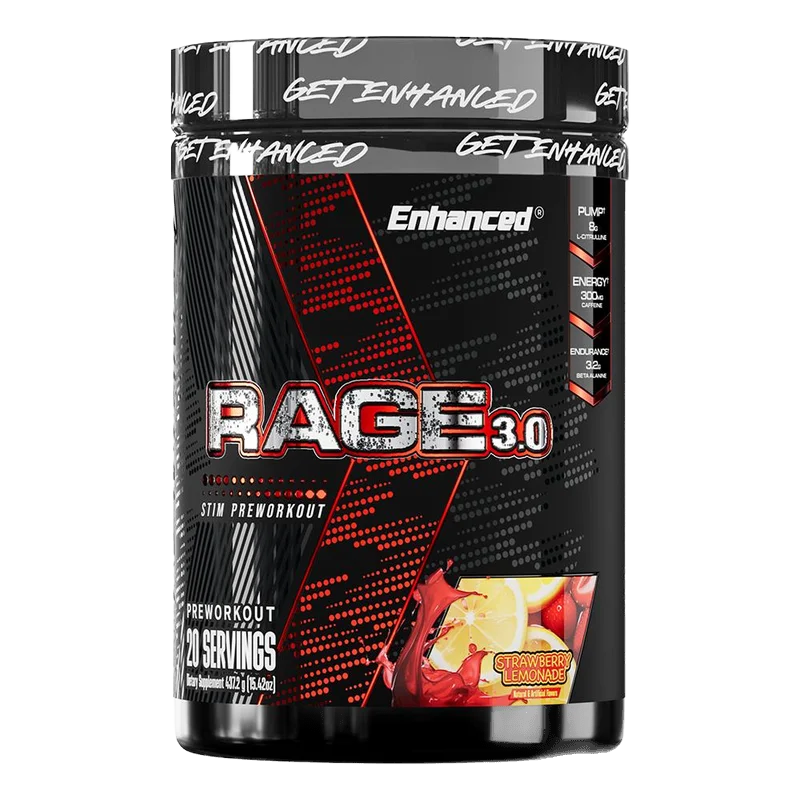
Enhanced Labs · Pre-workout
Enhanced Labs Rage 3.0
Label read twice, dated Sep 2026 · checked weeklyLast valid check Nov 1, 2026
Save to my LockerLabels
The labels, dated
One documented label. Read twice, dated, kept.
Dates are when we observed each label, not when it was made or shipped.
Current label, Strawberry Lemonade read Sep 26, 2026
- Vitamin B320 mg NE
- Vitamin B12250 mcg
- Magnesium5.39 mg
- Sodium120 mg
- Potassium27 mg
- L-Citrulline8 g
- Beta Alanine3.2 g
- Betaine2 g
No earlier label has been recovered yet. A missing observation is not proof nothing changed. The full panel is below.
What it means
The label you can check against.
What we found
The panel the brand published on Sep 26, 2026 was read twice, independently, and every compared field agreed. It declares 17 dosed lines. No confirmed formula change is on file for this product.
What we can’t tell you yet
A missing earlier label is not proof nothing changed, and a product record never establishes what is inside a particular tub. Dates are observation dates, not manufacture dates.
Signal Verified, here
What we checked. What we haven’t yet.
- Checked: Label read twice57 of 57 fields agreed on the Strawberry Lemonade panel from enhancedlabs.com, dated Sep 26, 2026.
- Checked: FlavorsEvery flavor on the brand's store is covered by a panel read.
- Not yet: Where it's soldBrand's own store only. Retail labels have not been compared.
- Not yet: Earlier labels1 dated label on file. The archive search is not complete, so an earlier label may exist.
- Checked: MarketUS market only.
- Checked: Kept currentRechecked within 180 days. If it is not re-verified by Mar 25, 2027, the status comes off.
Label read twice. Both readings agree. Not a laboratory test, safety certification, or endorsement of the product. How Signal Verified works
Monitoring
How we keep it current
Checked weekly
Last checked Nov 1, 2026. A fresh check is due.
- No change detected in this reading
- No change detected in this reading
- Could not check. The source did not give us a reading.
Earlier checks
- Could not check. The source did not give us a reading.
- Could not check. The source did not give us a reading.
- Could not check. The source did not give us a reading.
These are the Record’s own checks, not checks run for your account before you watched it.
FRESH CHECK
Buying again soon? Send this product to the front of the line and we’ll check the brand’s page again.
What a fresh check covers
Requests bring a source check forward. They do not scan your tub, guarantee a result, or start a subscription. Requests for the same product share a monitoring pass. Allowances reset monthly in UTC; guest allowances are shared by people on the same connection.
Formula
What's in it
The declared formula
Current formula observed September 26, 2026.
- Scoop size
- Not recorded
- Servings
- 20
- Caffeine
- Not computable
- Formula scope
- flavor specific
| Label wording | Share of the heaviest line | Amount |
|---|---|---|
| Vitamin B3 (as Niacin)vitamin b3 as niacin | 20 mg NE | |
| Vitamin B12 (as Methylcobalamin)vitamin b12 | 250 mcg | |
| Magnesium (from Magnesium Citrate)magnesium from magnesium citrate | 5.39 mg | |
| Sodium (from Himalayan Sea Salt)sodium from himalayan sea salt | 120 mg | |
| Potassium (from Potassium Citrate)potassium from potassium citrate | 27 mg | |
| L-Citrulline | 8 g | |
| Beta Alaninebeta-alanine | 3.2 g | |
| Betaine Anhydrous | 2 g | |
| L-Tyrosine | 2 g | |
| Taurine | 1 g | |
| AGmass® (Agmatine Sulfate)agmatine sulfate | 500 mg | |
| PurCaf® (Organic Caffeine from Green Coffee Bean)caffeine | 316 mg | |
| Alpha GPC 50% (L-Alpha Glycerlphosphorychlorine)alpha-gpc 50% material | 150 mg | |
| EndoFlo™ (Mango [Magnifera indica] Fruit Extract, Black Ginger [Keempferia paraviflora] Root Extract, Gingko [Gingko Biloba] Leaf Extract, Pine [Pinus massoniana] Bark Extractendoflo mango magnifera indica fruit extract black ginger keempferia paraviflora root extract gingko gingko biloba leaf extract pine pinus massoniana bark extract | 150 mg | |
| NeuroRush™ (Coffee [Coffea arabica] Fruit Extract)neurorush coffee coffea arabica fruit extract | 150 mg | |
| Huperzine Extract (std. 1% Huperzine A)huperzine extract std. 1% huperzine a | 5 mg | |
| Black Pepper Extract | 2.5 mg |
Bars compare declared weight per serving, line by line.
What it costs
Serving economics
What it costs
- $39.99Price shownObserved September 26, 2026
- 20Servings per containerCaptured with the price
- $2.00Per serving$39.99 ÷ 20 = $2.00 per serving
The price is a captured fact. The per-serving figures are FormulaSignal's arithmetic on it. Price never decides whether a label is Signal Verified.
Where to buy
Buy it, knowing which label you are getting.
Compare the label on the listing or the tub with the dated one above.
FormulaSignal earns nothing from these links. A seller's stock can carry an older label than the one dated here.
Sources
Evidence
Sources you can open. Each one dated.
Brand's own pageSep 26, 2026
The label shown here, read twice: 57 of 57 fields agreed
Enhanced Labs · enhancedlabs.com (opens in a new tab)
Research context
Research-dose context
This label beside selected research
Selected evidence, not a universal effective dose. It does not establish safety, effectiveness, or a dose recommendation for this product.
L-citrulline
A1- This label
- L-Citrulline: 8 g
- Studied range
- 3,000 to 9,000 mg
Study details and limits
- Protocol and duration
- per day, in the studies NIH ODS summarizes
- Studied context
- Studied as a nitric-oxide pathway precursor (converted to arginine via the urea cycle) for aerobic exercise performance measures such as oxygen-uptake (VO2) kinetics, blood lactate, and rate of perceived exertion, and for acute resistance-exercise performance and muscle oxygenation. NIH ODS describes evidence for enhancing performance as limited, with few studies and conflicting results.
- Limitations
- A 2022 systematic review/meta-analysis found no significant benefit for endurance-performance outcomes specifically. A single 8 g acute dose did not enhance isometric force production, muscle endurance, or muscle-oxygenation parameters in one resistance-exercise study. NIH ODS characterizes overall performance-enhancement evidence as limited.
Selected evidence: NIH ODS, Dietary Supplements for Exercise and Athletic Performance · Open source
Beta-alanine
A2- This label
- Beta Alanine: 3.2 g
- Studied range
- 4,000 to 6,000 mg
Study details and limits
- Protocol and duration
- per day in divided doses, for at least 2 to 4 weeks, not as a single pre-workout dose
- Studied context
- Studied for high-intensity exercise capacity in the 60-240 second range via elevation of muscle carnosine, which acts as an intracellular pH buffer against acidosis. ISSN 2015 position stand: greatest performance benefits in "open end-point" tasks/time trials lasting 1-4 minutes; some benefit noted in aerobic exercise up to roughly 25 minutes; attenuation of neuromuscular fatigue, particularly noted in older adults.
- Limitations
- Strength/resistance-training outcomes remain mixed; training volume may increase without a clear strength gain. Tasks under 60 seconds do not show benefit. Endurance benefit beyond about 25 minutes is not established. Long-term safety data beyond roughly a year, and effects in special/tactical populations, are flagged as needing more research.
Selected evidence: ISSN position stand on beta-alanine, 2015 · Open source
Betaine anhydrous
A1- This label
- Betaine Anhydrous: 2 g
- Studied range
- 2,000 to 5,000 mg
Study details and limits
- Protocol and duration
- per day, studied for up to 15 days
- Studied context
- NIH ODS describes betaine as studied for strength- and power-based performance in bodybuilders and cyclists, with "potential but modest" improvements from a limited set of small, sometimes conflicting studies. A 2024/2025 systematic review focused specifically on endurance performance (VO2max, time-to-exhaustion, time-to-completion, power output).
- Limitations
- The endurance systematic review explicitly states "limited and inconclusive evidence regarding the definitive ergogenic effect of betaine supplementation on endurance exercise performance". Only 2 of 5 reviewed studies showed a significant improvement, and the authors call for "additional, more rigorous research."
Selected evidence: NIH ODS, Dietary Supplements for Exercise and Athletic Performance · Open source
L-tyrosine
A2- This label
- L-Tyrosine: 2 g
- Studied range
- 2,000 to 2,000 mg
Study details and limits
- Protocol and duration
- per day for five days, in the cadet study
- Studied context
- Studied as the dietary precursor to norepinephrine for mitigating cognitive performance decrements under acute stress. A 2015 Military Medicine evidence review (rapid evidence assessment, 14 trials: 10 RCTs + 4 controlled clinical trials) issued a "weak recommendation" in favor of tyrosine for cognitive stress specifically, stating "all studies showed a positive effect" on that outcome. A widely cited primary study (Deijen et al. 1999, Brain Research Bulletin) gave cadets 2 g tyrosine daily for five days during a combat training course and found better memory and tracking-task performance, plus lower systolic blood pressure, versus a carbohydrate control.
- Limitations
- The 2015 Military Medicine review states explicitly that "no recommendation could be made" for tyrosine's effect on physical performance under stressful physical conditions, and concludes "available evidence is insufficient to make confident recommendations on the effectiveness of tyrosine for mitigating stress effects on physical/cognitive performance" overall, despite the positive signal on cognition. A separate heat-stress study found tyrosine ingestion did not influence cognitive function or physical performance during exercise heat stress despite raised serum tyrosine. NIH ODS's exercise/athletic-performance fact sheet does not cover tyrosine at all.
Selected evidence: Deijen et al., Brain Research Bulletin, 1999
Taurine
A2- This label
- Taurine: 1 g
- Studied range
- 1,000 to 3,000 mg
Study details and limits
- Protocol and duration
- per day, acutely across 6 to 15 days
- Studied context
- Studied for aerobic performance (VO2max, time-to-exhaustion, time-trial performance), anaerobic/strength performance, exercise-induced muscle damage, and recovery. A 2018 review ("Taurine in sports and exercise," PMC8152067) reports small-to-moderate improvements across several of these outcomes in some studies.
- Limitations
- The 2018 review states plainly: "limited and varied findings prohibit definitive conclusions regarding the efficacy of taurine on aerobic and anaerobic performance," and separately notes no peer-reviewed evidence exists for an independent role of taurine in skeletal-muscle hypertrophy.
Selected evidence: Taurine in sports and exercise, 2018 · Open source
Agmatine sulfate
A2- This label
- AGmass® (Agmatine Sulfate): 500 mg
- Studied range
- No dose range selected
Study details and limits
- Protocol and duration
- Not recorded in the selected comparison
- Studied context
- Human data is comparatively sparse. A randomized double-blind placebo-controlled trial studied oral agmatine sulfate (1,335-3,560 mg/day for up to 3 weeks) for lumbar disc-associated radiculopathy (a clinical/pain context, not sports performance). A 2019 Scientific Reports paper examined safety and neurochemical profiles of acute and sub-chronic oral agmatine sulfate treatment.
- Limitations
- Sports-performance-specific human efficacy data for agmatine sulfate (e.g., a dedicated ISSN position stand) was not located in this research pass. Evidence located centers on safety/tolerability and non-sports clinical contexts rather than an authoritative performance-outcome verdict. Long-term safety in larger populations remains an open gap per the safety literature reviewed.
Selected evidence: Safety and neurochemical profiles of oral agmatine sulfate, 2019 · Open source
Cautions and filings
Cautions and regulatory records
Cautions and filings
These attach to declared ingredients, not to this product as a whole. A filing and a documented risk are not the same thing. Talk with a qualified health professional.
Documented cautions on declared ingredients
SAFETY ADVISORY · A2
Alpha-GPC 50% material. This material is standardized to Alpha-GPC. A 2021 JAMA Network Open study of about 12 million adults reported an association between alpha-GPC use and 10-year stroke risk, in a dose and duration response pattern. The authors flag confounding, and association is not causation.
Association of L-alpha Glycerylphosphorylcholine With Subsequent Stroke Risk After 10 Years, JAMA Network Open · Open source
The rest of the Record
Also checked
Formula history
No confirmed change on file. Historical evidence is not yet enough to compare, which does not establish that the product never changed.
Source conflicts
No source conflict is recorded on this Record. That is not a claim that every source agrees, only that none we read disagreed.
Common questions
Questions
Enhanced Labs RAGE 3.0: common questions
How much caffeine is in Enhanced Labs RAGE 3.0?
The label observed September 26, 2026 declares caffeine from 1 declared source (PurCaf® (Organic Caffeine from Green Coffee Bean) 316 mg), with no total published by FormulaSignal.
What are the ingredients in Enhanced Labs RAGE 3.0?
The label observed September 26, 2026 declares 17 lines. The actives: Vitamin B3 (as Niacin) (20 mg NE), Magnesium (from Magnesium Citrate) (5.39 mg), Sodium (from Himalayan Sea Salt) (120 mg), Potassium (from Potassium Citrate) (27 mg), L-citrulline (8 g), Beta-alanine (3.2 g), Betaine anhydrous (2 g), L-tyrosine (2 g), and 6 more listed in full above. Vitamins, minerals and electrolytes are in the full table.
How much does Enhanced Labs RAGE 3.0 cost per serving?
$2.00: $39.99 for 20 servings, observed September 26, 2026 (the price shown). About $43.33 a month at five uses a week.
Has Enhanced Labs RAGE 3.0 changed its formula?
FormulaSignal has not confirmed a change. That is a statement about the evidence on file, not a finding that the formula never changed.
Is Enhanced Labs RAGE 3.0 good?
FormulaSignal does not score products or say whether one works. What the label shows: 2 of 3 main actives are declared inside the dose range the cited research used; 17 of 17 ingredient lines disclose an amount; and at $2.00 a serving it ranks 454 of 627 covered products with an observed price, cheapest first. Whether it suits you depends on your caffeine tolerance, your budget and what you avoid.