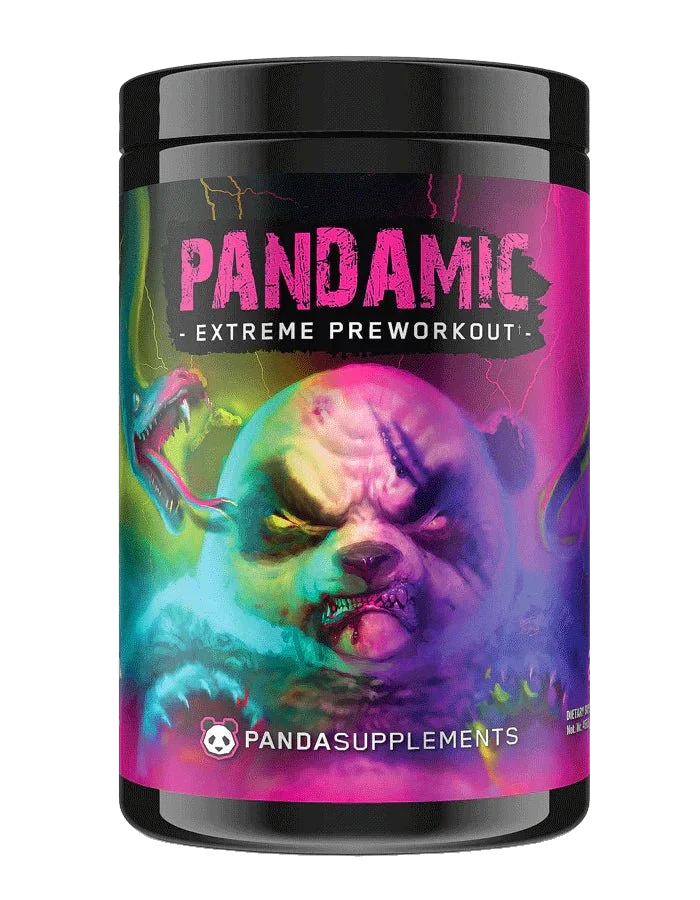
Panda Supplements · Pre-workout
Panda Supplements Pandamic Pre-workout
Label read twice, dated Oct 2026 · checked weeklyLast valid check Nov 6, 2026
Save to my LockerLabels
The labels, dated
One documented label. Read twice, dated, kept.
Dates are when we observed each label, not when it was made or shipped.
Current label, Raspberry Lemonade read Oct 30, 2026
- Sodium35 mg
- L-Citrulline Malate 2:19000 mg
- Beta Alanine3200 mg
- Betaine2500 mg
- L-Tyrosine750 mg
- Alpha GPC 50%400 mg
- Caffeine350 mg
- Theobromine200 mg
No earlier label has been recovered yet. A missing observation is not proof nothing changed. The full panel is below.
What it means
The label you can check against.
What we found
The panel the brand published on Oct 30, 2026 was read twice, independently, and every compared field agreed. It declares 12 dosed lines. No confirmed formula change is on file for this product.
What we can’t tell you yet
A missing earlier label is not proof nothing changed, and a product record never establishes what is inside a particular tub. Dates are observation dates, not manufacture dates.
Signal Verified, here
What we checked. What we haven’t yet.
- Checked: Label read twice42 of 42 fields agreed on the Raspberry Lemonade panel from pandasupps.com, dated Oct 30, 2026.
- Not yet: FlavorsRead: Raspberry Lemonade. 6 of 7 flavors on the store are not read yet.
- Not yet: Where it's soldBrand's own store only. Retail labels have not been compared.
- Not yet: Earlier labels1 dated label on file. The archive search is not complete, so an earlier label may exist.
- Checked: MarketUS market only.
- Checked: Kept currentRechecked within 180 days. If it is not re-verified by Apr 28, 2027, the status comes off.
Label read twice. Both readings agree. Not a laboratory test, safety certification, or endorsement of the product. How Signal Verified works
Monitoring
How we keep it current
Checked weekly
Last checked Nov 6, 2026.
- No change detected in this reading
- No change detected in this reading
These are the Record’s own checks, not checks run for your account before you watched it.
FRESH CHECK
Buying again soon? Send this product to the front of the line and we’ll check the brand’s page again.
What a fresh check covers
Requests bring a source check forward. They do not scan your tub, guarantee a result, or start a subscription. Requests for the same product share a monitoring pass. Allowances reset monthly in UTC; guest allowances are shared by people on the same connection.
Formula
What's in it
The declared formula
Current formula observed October 30, 2026.
- Scoop size
- Not recorded
- Servings
- 25
- Caffeine
- Not computable
- Formula scope
- flavor specific
| Label wording | Share of the heaviest line | Amount |
|---|---|---|
| Sodium (from Pink Himalayan Sea Salt)sodium from pink himalayan sea salt | 35 mg | |
| L-Citrulline Malate 2:1citrulline malate | 9000 mg | |
| Beta Alaninebeta-alanine | 3200 mg | |
| Betaine Anhydrous | 2500 mg | |
| L-Tyrosine | 750 mg | |
| Alpha GPC 50% (Alpha Glycerylphosphorylcholine)alpha-gpc 50% material | 400 mg | |
| Caffeine Anhydrouscaffeine | 350 mg | |
| Theobromine | 200 mg | |
| Dendrobium Extract (Dendrobium nobile)(Stem)dendrobium extract dendrobium nobile stem | 100 mg | |
| Mucuna Pruriens Powder Extract (98% L-Dopa)(Seed)mucuna pruriens powder extract 98% l-dopa seed | 100 mg | |
| AstraGin® (Purified & Fractionated Panax notoginseng and Astragalus membranaceus)astragin purified fractionated panax notoginseng and astragalus membranaceus | 50 mg | |
| Synephrine HCl | 50 mg |
Bars compare declared weight per serving, line by line.
What it costs
Serving economics
What it costs
- $54.99Price shownObserved October 30, 2026
- 25Servings per containerCaptured with the price
- $2.20Per serving$54.99 ÷ 25 = $2.20 per serving
The price is a captured fact. The per-serving figures are FormulaSignal's arithmetic on it. Price never decides whether a label is Signal Verified.
Where to buy
Buy it, knowing which label you are getting.
Compare the label on the listing or the tub with the dated one above.
FormulaSignal earns nothing from these links. A seller's stock can carry an older label than the one dated here.
Sources
Evidence
More sources on the Record
P1 commercial capture
October 30, 2026
Open source evidence (opens in a new tab)
Evidence
Sources you can open. Each one dated.
Brand's own pageOct 30, 2026
The label shown here, read twice: 42 of 42 fields agreed
Panda Supplements · pandasupps.com (opens in a new tab)
Research context
Research-dose context
This label beside selected research
Selected evidence, not a universal effective dose. It does not establish safety, effectiveness, or a dose recommendation for this product.
Citrulline malate
A2- This label
- L-Citrulline Malate 2:1: 9000 mg
- Studied range
- 6,000 to 8,000 mg
Study details and limits
- Protocol and duration
- single acute dose, 40 to 60 minutes before training
- Studied context
- Studied for resistance-exercise repetition performance/muscular endurance, cycling performance, muscle-damage recovery, and muscle soreness. A 2021 critical review notes a single acute 8 g dose "may, albeit not consistently, increase muscular endurance-strength performance," with a meta-analysis finding an average 6.4% increase in repetitions with 6-8 g dosed 40-60 minutes pre-exercise, with a stronger trend for lower-body than upper-body exercises.
- Limitations
- The same review states there is "little evidence to advocate its use in the production and maintenance of muscular power, maximal strength, recovery of muscular function, or supporting muscular adaptations," calls cycling-performance effects "scarce," and says claims about reduced muscle soreness lack consistent support. Overall efficacy is called "ambiguous." The review also flags a real-world quality-control problem: commercial products often do not match the citrulline:malate ratio used in the research they cite.
Selected evidence: A critical review of citrulline malate supplementation and exercise performance, 2021 · Open source
Beta-alanine
A2- This label
- Beta Alanine: 3200 mg
- Studied range
- 4,000 to 6,000 mg
Study details and limits
- Protocol and duration
- per day in divided doses, for at least 2 to 4 weeks, not as a single pre-workout dose
- Studied context
- Studied for high-intensity exercise capacity in the 60-240 second range via elevation of muscle carnosine, which acts as an intracellular pH buffer against acidosis. ISSN 2015 position stand: greatest performance benefits in "open end-point" tasks/time trials lasting 1-4 minutes; some benefit noted in aerobic exercise up to roughly 25 minutes; attenuation of neuromuscular fatigue, particularly noted in older adults.
- Limitations
- Strength/resistance-training outcomes remain mixed; training volume may increase without a clear strength gain. Tasks under 60 seconds do not show benefit. Endurance benefit beyond about 25 minutes is not established. Long-term safety data beyond roughly a year, and effects in special/tactical populations, are flagged as needing more research.
Selected evidence: ISSN position stand on beta-alanine, 2015 · Open source
Betaine anhydrous
A1- This label
- Betaine Anhydrous: 2500 mg
- Studied range
- 2,000 to 5,000 mg
Study details and limits
- Protocol and duration
- per day, studied for up to 15 days
- Studied context
- NIH ODS describes betaine as studied for strength- and power-based performance in bodybuilders and cyclists, with "potential but modest" improvements from a limited set of small, sometimes conflicting studies. A 2024/2025 systematic review focused specifically on endurance performance (VO2max, time-to-exhaustion, time-to-completion, power output).
- Limitations
- The endurance systematic review explicitly states "limited and inconclusive evidence regarding the definitive ergogenic effect of betaine supplementation on endurance exercise performance". Only 2 of 5 reviewed studies showed a significant improvement, and the authors call for "additional, more rigorous research."
Selected evidence: NIH ODS, Dietary Supplements for Exercise and Athletic Performance · Open source
L-tyrosine
A2- This label
- L-Tyrosine: 750 mg
- Studied range
- 2,000 to 2,000 mg
Study details and limits
- Protocol and duration
- per day for five days, in the cadet study
- Studied context
- Studied as the dietary precursor to norepinephrine for mitigating cognitive performance decrements under acute stress. A 2015 Military Medicine evidence review (rapid evidence assessment, 14 trials: 10 RCTs + 4 controlled clinical trials) issued a "weak recommendation" in favor of tyrosine for cognitive stress specifically, stating "all studies showed a positive effect" on that outcome. A widely cited primary study (Deijen et al. 1999, Brain Research Bulletin) gave cadets 2 g tyrosine daily for five days during a combat training course and found better memory and tracking-task performance, plus lower systolic blood pressure, versus a carbohydrate control.
- Limitations
- The 2015 Military Medicine review states explicitly that "no recommendation could be made" for tyrosine's effect on physical performance under stressful physical conditions, and concludes "available evidence is insufficient to make confident recommendations on the effectiveness of tyrosine for mitigating stress effects on physical/cognitive performance" overall, despite the positive signal on cognition. A separate heat-stress study found tyrosine ingestion did not influence cognitive function or physical performance during exercise heat stress despite raised serum tyrosine. NIH ODS's exercise/athletic-performance fact sheet does not cover tyrosine at all.
Selected evidence: Deijen et al., Brain Research Bulletin, 1999
Theobromine
A1- This label
- Theobromine: 200 mg
- Studied range
- No dose range selected
Study details and limits
- Protocol and duration
- Not recorded in the selected comparison
- Studied context
- EFSA's Panel on Food Contact Materials, Enzymes, Flavourings and Processing Aids (CEF), in its 2017 opinion on xanthine alkaloids from the flavoring priority list, treats theobromine as a major metabolite of caffeine. Roughly 11% of an ingested caffeine dose converts systemically to theobromine. And states that because "only limited toxicity data in humans are available" for theobromine directly, its safety assessment leans on the extensive caffeine safety literature (EFSA's 2015 caffeine opinion) rather than an independent human-efficacy dataset for theobromine as a standalone ergogenic ingredient.
- Limitations
- No sports-performance-specific position stand or ISSN evaluation of theobromine as a standalone ergogenic ingredient was located in this research pass. EFSA's own framing acknowledges limited independent human toxicity data on theobromine itself.
Selected evidence: EFSA Flavouring Group Evaluation 49 Revision 1, 2017 · Open source
Synephrine HCl
A1- This label
- Synephrine HCl: 50 mg
- Studied range
- No dose range selected
Study details and limits
- Protocol and duration
- Not recorded in the selected comparison
- Studied context
- Synephrine is the principal amine discussed in authoritative reviews of bitter orange (Citrus aurantium) products. Human studies have examined cardiovascular measures and weight-loss or exercise contexts, but many products also contained caffeine or other ingredients.
- Limitations
- NCCIH reports inconsistent cardiovascular findings and says the role of bitter orange or p-synephrine cannot be isolated in many adverse-event reports. A label amount without a verified p-synephrine assay is not treated as a measured p-synephrine dose.
Selected evidence: Bitter Orange: Usefulness and Safety, NCCIH · Open source
Cautions and filings
Cautions and regulatory records
Cautions and filings
These attach to declared ingredients, not to this product as a whole. A filing and a documented risk are not the same thing. Talk with a qualified health professional.
Documented cautions on declared ingredients
SAFETY ADVISORY · A2
Alpha-GPC 50% material. This material is standardized to Alpha-GPC. A 2021 JAMA Network Open study of about 12 million adults reported an association between alpha-GPC use and 10-year stroke risk, in a dose and duration response pattern. The authors flag confounding, and association is not causation.
Association of L-alpha Glycerylphosphorylcholine With Subsequent Stroke Risk After 10 Years, JAMA Network Open · Open source
SAFETY ADVISORY · A1
Synephrine HCl. NCCIH reports serious cardiovascular events in some people using bitter-orange products, while noting that most products were multi-ingredient and the role of bitter orange or p-synephrine cannot be isolated. Treat this as a safety advisory and do not treat it as proof of harm from this product's label alone.
Bitter Orange: Usefulness and Safety, NCCIH · Open source
The rest of the Record
Also checked
Formula history
No confirmed change on file. Historical evidence is not yet enough to compare, which does not establish that the product never changed.
Source conflicts
No source conflict is recorded on this Record. That is not a claim that every source agrees, only that none we read disagreed.
Common questions
Questions
Panda Supplements PANDAMIC PRE-WORKOUT: common questions
How much caffeine is in Panda Supplements PANDAMIC PRE-WORKOUT?
The label observed October 30, 2026 declares caffeine from 1 declared source (Caffeine Anhydrous 350 mg), with no total published by FormulaSignal.
What are the ingredients in Panda Supplements PANDAMIC PRE-WORKOUT?
The label observed October 30, 2026 declares 12 lines. The actives: Sodium (from Pink Himalayan Sea Salt) (35 mg), Citrulline malate (9000 mg), Beta-alanine (3200 mg), Betaine anhydrous (2500 mg), L-tyrosine (750 mg), Alpha-GPC 50% material (400 mg), Theobromine (200 mg), Dendrobium Extract (Dendrobium nobile)(Stem) (100 mg), and 3 more listed in full above. Vitamins, minerals and electrolytes are in the full table.
How much does Panda Supplements PANDAMIC PRE-WORKOUT cost per serving?
$2.20: $54.99 for 25 servings, observed October 30, 2026 (the price shown). About $47.66 a month at five uses a week.
Has Panda Supplements PANDAMIC PRE-WORKOUT changed its formula?
FormulaSignal has not confirmed a change. That is a statement about the evidence on file, not a finding that the formula never changed.
Is Panda Supplements PANDAMIC PRE-WORKOUT good?
FormulaSignal does not score products or say whether one works. What the label shows: 1 of 3 main actives are declared inside the dose range the cited research used; 12 of 12 ingredient lines disclose an amount; and at $2.20 a serving it ranks 503 of 627 covered products with an observed price, cheapest first. Whether it suits you depends on your caffeine tolerance, your budget and what you avoid.