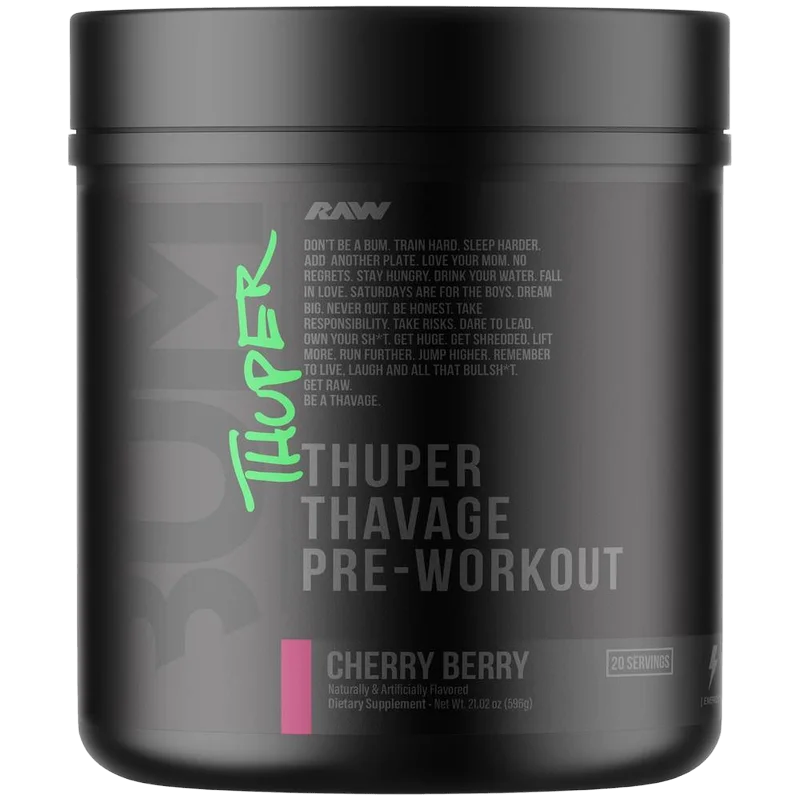
RAW Nutrition · Pre-workout
RAW Nutrition Thuper Thavage Pre-Workout
Label on file, dated Aug 2026 · checked weeklyLast valid check Nov 1, 2026
Save to my LockerLabels
Record stale
No qualifying observation falls inside the current freshness window.
At a glance
Label dated August 3, 2026
- 400 mgCaffeine per serving
- 20Servings on the label
- $3.00Per serving$59.99 ÷ 20
Label transparencyAll 14 lines show an amount
No confirmed formula change · not a claim it never changed
Checked weekly · last November 1, 2026
The short answer: RAW Nutrition Thuper Thavage Pre-Workout declares 400 mg of caffeine per serving on the label FormulaSignal observed August 3, 2026. All 14 of its declared ingredient lines carry an amount. It costs $3.00 a serving at the price shown on Aug 3, 2026.
The Record in one paragraph
RAW Nutrition Thuper Thavage Pre-Workout has a stale Record. Latest source capture October 4, 2026. The current public formula contains 14 declared ingredient lines. Comparable formula history is not yet available.
Monitoring
How we keep it current
Checked weekly
Last checked Nov 1, 2026. A fresh check is due.
- No change detected in this reading
- Something on the brand's page looked different. It is being reviewed and is not a confirmed change.
- No change detected in this reading
Earlier checks
- No change detected in this reading
- No change detected in this reading
- No change detected in this reading
These are the Record’s own checks, not checks run for your account before you watched it.
FRESH CHECK
Buying again soon? Send this product to the front of the line and we’ll check the brand’s page again.
What a fresh check covers
Requests bring a source check forward. They do not scan your tub, guarantee a result, or start a subscription. Requests for the same product share a monitoring pass. Allowances reset monthly in UTC; guest allowances are shared by people on the same connection.
Formula
What's in it
The declared formula
Current formula observed August 3, 2026.
- Scoop size
- Not recorded
- Servings
- 20
- Caffeine
- 400 mg per serving
- Formula scope
- flavor specific
| Label wording | Share of the heaviest line | Amount |
|---|---|---|
| Sodium (as Himalayan Pink Salt)sodium as himalayan pink salt | 180 mg | |
| Beta Alaninebeta-alanine | 6.4 g | |
| L-Citrulline | 6 g | |
| Creatine Monohydrate | 5 g | |
| Betaine Nitrate (as NO3-T)betaine nitrate | 2 g | |
| Taurine | 2 g | |
| PeakO2 (Cordyceps militaris, Ganoderma lucidum, Pleurotus eryngii, Lentinula edodes, Hericium erinaceus, Trametes versicolor)peako2 cordyceps militaris ganoderma lucidum pleurotus eryngii lentinula edodes hericium erinaceus trametes versicolor | 1 g | |
| Agmatine Sulfate | 1 g | |
| Alpha GPC (Alpha-Glycerol Phosphoryl Choline 50%)alpha-gpc 50% material | 1 g | |
| Caffeine Anhydrouscaffeine | 400 mg | |
| Juniper (Juniperus communis) (Fruit) Berry Extractjuniper juniperus communis fruit berry extract | 220 mg | |
| L-Theanine | 200 mg | |
| Theobromine | 100 mg | |
| Alpha Yohimbine | 2.5 mg |
Bars compare declared weight per serving, line by line.
What it costs
Serving economics
What it costs
- $59.99Price shownObserved August 3, 2026
- 20Servings per containerCaptured with the price
- $3.00Per serving$59.99 ÷ 20 = $3.00 per serving
The price is a captured fact. The per-serving figures are FormulaSignal's arithmetic on it.
Where to buy
Buy it, knowing which label you are getting.
Compare the label on the listing or the tub with the dated one above.
As an Amazon Associate FormulaSignal earns from qualifying purchases. The link goes to the Amazon listing for this product. It is not a recommendation, and it cannot change anything the Record says or how anything is ordered. Choose the flavor and size on the seller’s page; this link does not establish the price or package shown in the Record. A listing can show an older label, so compare its label photo before you buy.
Sources
Evidence
Every source, dated
P1 current formula source
August 3, 2026
Open source evidence (opens in a new tab)P1 commercial capture
August 3, 2026
Open source evidence (opens in a new tab)
Research context
Research-dose context
This label beside selected research
Selected evidence, not a universal effective dose. It does not establish safety, effectiveness, or a dose recommendation for this product.
Beta-alanine
A2- This label
- Beta Alanine: 6.4 g
- Studied range
- 4,000 to 6,000 mg
Study details and limits
- Protocol and duration
- per day in divided doses, for at least 2 to 4 weeks, not as a single pre-workout dose
- Studied context
- Studied for high-intensity exercise capacity in the 60-240 second range via elevation of muscle carnosine, which acts as an intracellular pH buffer against acidosis. ISSN 2015 position stand: greatest performance benefits in "open end-point" tasks/time trials lasting 1-4 minutes; some benefit noted in aerobic exercise up to roughly 25 minutes; attenuation of neuromuscular fatigue, particularly noted in older adults.
- Limitations
- Strength/resistance-training outcomes remain mixed; training volume may increase without a clear strength gain. Tasks under 60 seconds do not show benefit. Endurance benefit beyond about 25 minutes is not established. Long-term safety data beyond roughly a year, and effects in special/tactical populations, are flagged as needing more research.
Selected evidence: ISSN position stand on beta-alanine, 2015 · Open source
L-citrulline
A1- This label
- L-Citrulline: 6 g
- Studied range
- 3,000 to 9,000 mg
Study details and limits
- Protocol and duration
- per day, in the studies NIH ODS summarizes
- Studied context
- Studied as a nitric-oxide pathway precursor (converted to arginine via the urea cycle) for aerobic exercise performance measures such as oxygen-uptake (VO2) kinetics, blood lactate, and rate of perceived exertion, and for acute resistance-exercise performance and muscle oxygenation. NIH ODS describes evidence for enhancing performance as limited, with few studies and conflicting results.
- Limitations
- A 2022 systematic review/meta-analysis found no significant benefit for endurance-performance outcomes specifically. A single 8 g acute dose did not enhance isometric force production, muscle endurance, or muscle-oxygenation parameters in one resistance-exercise study. NIH ODS characterizes overall performance-enhancement evidence as limited.
Selected evidence: NIH ODS, Dietary Supplements for Exercise and Athletic Performance · Open source
Creatine monohydrate
A2- This label
- Creatine Monohydrate: 5 g
- Studied range
- 3,000 to 5,000 mg
Study details and limits
- Protocol and duration
- per day maintenance, after an optional loading phase
- Studied context
- The ISSN 2017 position stand calls creatine monohydrate "the most effective ergogenic nutritional supplement currently available to athletes" for increasing high-intensity/intermittent exercise capacity and lean body mass during training. It also describes research into post-exercise recovery, injury prevention, thermoregulation, rehabilitation, concussion/spinal-cord neuroprotection, and use in clinical populations (aging-related sarcopenia, neurodegenerative disease, type 2 diabetes glycemic control), while noting creatine is "of little value" for pure endurance sports (per NIH ODS).
- Limitations
- ISSN 2017 states it is not yet established whether other creatine forms (e.g., creatine nitrate, or precursors like guanidinoacetic acid/GAA) produce greater muscle or brain creatine uptake than monohydrate. This is described as an active area of research, not a settled finding.
Selected evidence: ISSN position stand on creatine safety and efficacy, 2017 · Open source
Taurine
A2- This label
- Taurine: 2 g
- Studied range
- 1,000 to 3,000 mg
Study details and limits
- Protocol and duration
- per day, acutely across 6 to 15 days
- Studied context
- Studied for aerobic performance (VO2max, time-to-exhaustion, time-trial performance), anaerobic/strength performance, exercise-induced muscle damage, and recovery. A 2018 review ("Taurine in sports and exercise," PMC8152067) reports small-to-moderate improvements across several of these outcomes in some studies.
- Limitations
- The 2018 review states plainly: "limited and varied findings prohibit definitive conclusions regarding the efficacy of taurine on aerobic and anaerobic performance," and separately notes no peer-reviewed evidence exists for an independent role of taurine in skeletal-muscle hypertrophy.
Selected evidence: Taurine in sports and exercise, 2018 · Open source
Agmatine sulfate
A2- This label
- Agmatine Sulfate: 1 g
- Studied range
- No dose range selected
Study details and limits
- Protocol and duration
- Not recorded in the selected comparison
- Studied context
- Human data is comparatively sparse. A randomized double-blind placebo-controlled trial studied oral agmatine sulfate (1,335-3,560 mg/day for up to 3 weeks) for lumbar disc-associated radiculopathy (a clinical/pain context, not sports performance). A 2019 Scientific Reports paper examined safety and neurochemical profiles of acute and sub-chronic oral agmatine sulfate treatment.
- Limitations
- Sports-performance-specific human efficacy data for agmatine sulfate (e.g., a dedicated ISSN position stand) was not located in this research pass. Evidence located centers on safety/tolerability and non-sports clinical contexts rather than an authoritative performance-outcome verdict. Long-term safety in larger populations remains an open gap per the safety literature reviewed.
Selected evidence: Safety and neurochemical profiles of oral agmatine sulfate, 2019 · Open source
L-theanine
A2- This label
- L-Theanine: 200 mg
- Studied range
- 12 to 400 mg
Study details and limits
- Protocol and duration
- per day across trials, with most using 200 mg
- Studied context
- Studied for attention/reaction-time measures and for stress-related relaxation without sedation. A meta-analysis/systematic review of 31 randomized controlled trials (n=1,168) found a single 200 mg dose taken 30-60 minutes before testing significantly improved choice reaction time (SMD = 0.51, 95% CI 0.25-0.77); a subset of 5 RCTs in 148 healthy adults found a dose-dependent effect on rapid visual information processing and recognition visual reaction time.
- Limitations
- The review describing itself as "promising, but not completely conclusive" signals the overall evidence base has not reached firm consensus strength despite the positive reaction-time finding.
Selected evidence: Systematic review and meta-analysis of L-theanine on cognitive performance · Open source
Theobromine
A1- This label
- Theobromine: 100 mg
- Studied range
- No dose range selected
Study details and limits
- Protocol and duration
- Not recorded in the selected comparison
- Studied context
- EFSA's Panel on Food Contact Materials, Enzymes, Flavourings and Processing Aids (CEF), in its 2017 opinion on xanthine alkaloids from the flavoring priority list, treats theobromine as a major metabolite of caffeine. Roughly 11% of an ingested caffeine dose converts systemically to theobromine. And states that because "only limited toxicity data in humans are available" for theobromine directly, its safety assessment leans on the extensive caffeine safety literature (EFSA's 2015 caffeine opinion) rather than an independent human-efficacy dataset for theobromine as a standalone ergogenic ingredient.
- Limitations
- No sports-performance-specific position stand or ISSN evaluation of theobromine as a standalone ergogenic ingredient was located in this research pass. EFSA's own framing acknowledges limited independent human toxicity data on theobromine itself.
Selected evidence: EFSA Flavouring Group Evaluation 49 Revision 1, 2017 · Open source
Caffeine
A2- This label
- Total caffeine from all declared sources: 400 mg
- Studied range
- 140 to 420 mg
Study details and limits
- Protocol and duration
- 2 to 6 mg per kg body mass, 15 to 60 minutes before exercise, shown here for a 70 kg adult
- Studied context
- Studied for endurance-type aerobic exercise (moderate to large ergogenic effect, most consistent evidence category per ISSN 2021), muscular endurance and movement velocity in resistance exercise (small to moderate effects), sprinting/jumping/throwing (2-7% improvements), and cognitive attention/vigilance under fatigue. NIH ODS notes it "might enhance performance in endurance-type activities... And intermittent, long-duration activities."
- Limitations
- Minimal effective dose remains unclear. Repeated-sprint performance benefit is inconsistent and the ISSN position stand says this "requires further research." Effects of habitual/chronic caffeine use on the ergogenic response are described as equivocal.
Selected evidence: ISSN position stand on caffeine and exercise performance, 2021, with NIH ODS · Open source
Cautions and filings
Cautions and regulatory records
Cautions and filings
These attach to declared ingredients, not to this product as a whole. A filing and a documented risk are not the same thing. Talk with a qualified health professional.
Documented cautions on declared ingredients
SAFETY ADVISORY · A1
Stimulant-load gate. The current record declares 400 mg of caffeine per serving, which triggers FormulaSignal's 300 mg stimulant-load gate. That 300 mg is our own screening threshold, not a regulatory limit. We set it there because NIH ODS summarizes an FDA reference point of 400 mg per day for healthy adults, so a single serving at 300 mg uses three quarters of that daily figure before any coffee, tea, or soda is counted. The gate flags that headroom is small. It is not a finding that the product is unsafe, and individual responses vary.
Dietary Supplements for Exercise and Athletic Performance, NIH Office of Dietary Supplements · Open source
SAFETY ADVISORY · A2
Alpha-GPC 50% material. This material is standardized to Alpha-GPC. A 2021 JAMA Network Open study of about 12 million adults reported an association between alpha-GPC use and 10-year stroke risk, in a dose and duration response pattern. The authors flag confounding, and association is not causation.
Association of L-alpha Glycerylphosphorylcholine With Subsequent Stroke Risk After 10 Years, JAMA Network Open · Open source
The rest of the Record
Also checked
Formula history
No confirmed change on file. Historical evidence is not yet enough to compare, which does not establish that the product never changed.
Source conflicts
No source conflict is recorded on this Record. That is not a claim that every source agrees, only that none we read disagreed.
Common questions
Questions
RAW Nutrition Thuper Thavage Pre-Workout: common questions
How much caffeine is in RAW Nutrition Thuper Thavage Pre-Workout?
400 mg per serving, on the label FormulaSignal observed August 3, 2026. A label date is not a manufacture date, so a tub bought earlier may carry an earlier label.
What are the ingredients in RAW Nutrition Thuper Thavage Pre-Workout?
The label observed August 3, 2026 declares 14 lines. The actives: Sodium (as Himalayan Pink Salt) (180 mg), Beta-alanine (6.4 g), L-citrulline (6 g), Creatine monohydrate (5 g), Betaine Nitrate (as NO3-T) (2 g), Taurine (2 g), PeakO2 (Cordyceps militaris, Ganoderma lucidum, Pleurotus eryngii, Lentinula edodes, Hericium erinaceus, Trametes versicolor) (1 g), Agmatine sulfate (1 g), and 5 more listed in full above. Vitamins, minerals and electrolytes are in the full table.
How much does RAW Nutrition Thuper Thavage Pre-Workout cost per serving?
$3.00: $59.99 for 20 servings, observed August 3, 2026 (the price shown). About $65.00 a month at five uses a week.
Has RAW Nutrition Thuper Thavage Pre-Workout changed its formula?
FormulaSignal has not confirmed a change. That is a statement about the evidence on file, not a finding that the formula never changed.
Is RAW Nutrition Thuper Thavage Pre-Workout good?
FormulaSignal does not score products or say whether one works. What the label shows: 3 of 4 main actives are declared inside the dose range the cited research used; 14 of 14 ingredient lines disclose an amount; and at $3.00 a serving it ranks 602 of 627 covered products with an observed price, cheapest first. Whether it suits you depends on your caffeine tolerance, your budget and what you avoid.