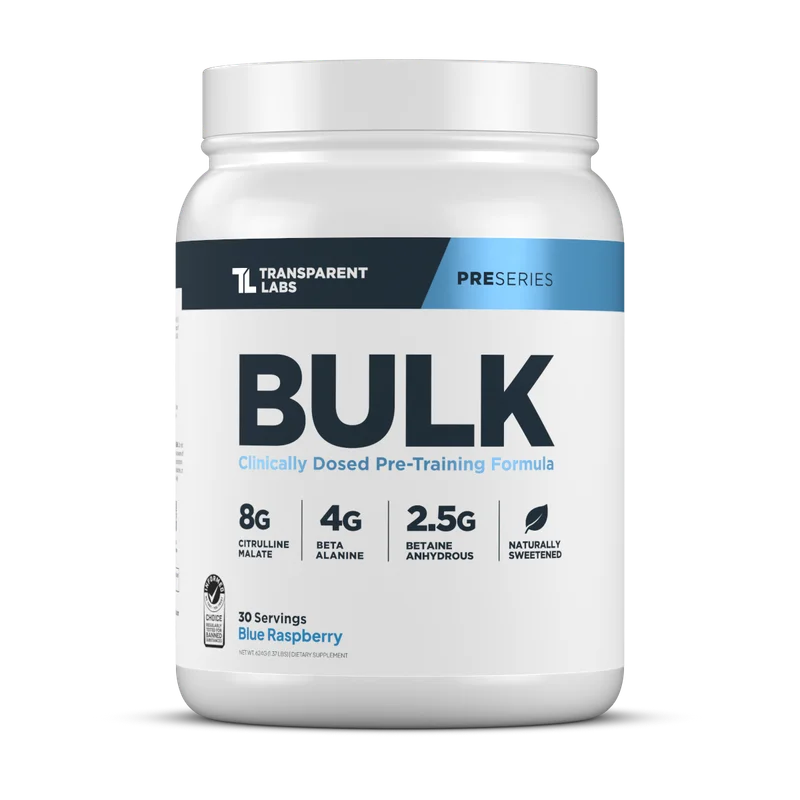
Transparent Labs · Pre-workout
Transparent Labs Bulk
Record under review
A newer source finding is open. Until review settles it, the formula below stays the one on the label dated July 25, 2026. Nothing is wrong with the product because of it.
At a glance
Label dated July 25, 2026
- 200 mgCaffeine per serving
- 30Servings on the label
- $1.67Per serving$49.99 ÷ 30
Label transparencyAll 17 lines show an amount
Checked weekly · last October 12, 2026
The short answer: Transparent Labs BULK declares 200 mg of caffeine per serving on the label FormulaSignal observed July 25, 2026. All 17 of its declared ingredient lines carry an amount. It costs $1.67 a serving at the price shown on Oct 4, 2026. Its formula has changed: FormulaSignal has confirmed one change, shown below with both dated sources.
The Record in one paragraph
Transparent Labs BULK has an under-review Record. Latest source capture October 4, 2026. The current public formula contains 17 declared ingredient lines. Comparable dated states are published as a confirmed Signal rather than as a timeline.
Keep a dated label reference free. Monitoring is optional.
What's in it
The declared formula
Current formula observed July 25, 2026.
- Scoop size
- Not recorded
- Servings
- 30
- Caffeine
- 200 mg per serving
- Formula scope
- flavor specific
| Label wording | Share of the heaviest line | Amount |
|---|---|---|
| L-Citrulline Malate (2:1)citrulline malate | 8000 mg | |
| Beta-Alanine | 4000 mg | |
| BetaPure Betaine Anhydrousbetaine anhydrous | 2500 mg | |
| Taurine | 1300 mg | |
| L-Tyrosine | 1000 mg | |
| AlphaSize Alpha-GPCalpha-gpc | 300 mg | |
| PurCaf Organic Caffeinecaffeine | 200 mg | |
| L-Theanine | 200 mg | |
| Theobromine | 50 mg | |
| SenActiv | 50 mg | |
| BioPerineblack pepper extract | 5 mg | |
| Boron Citrateboron | 3 mg | |
| Zinc Chelatezinc | 10 mg | |
| Vitamin B6 | 5 mg | |
| Vitamin B12 | 100 mcg | |
| Sodium | 180 mg | |
| Potassium | 125 mg |
Bars compare declared weight per serving, line by line.
Serving economics
What it costs
- $49.99Price shownObserved October 4, 2026
- 30Servings per containerCaptured with the price
- $1.67Per serving$49.99 ÷ 30 = $1.67 per serving
The price is a captured fact. The per-serving figures are FormulaSignal's arithmetic on it.
Formula history
Has the formula changed?
Dates below are observation dates. They are not exact reformulation dates. Latest capture October 4, 2026, of any kind.
Comparable dated states exist under a different identity scope and are published as a confirmed Signal.
Research-dose context
This label beside selected research
Selected evidence, not a universal effective dose. It does not establish safety, effectiveness, or a dose recommendation for this product.
Citrulline malate
A2- This label
- L-Citrulline Malate (2:1): 8000 mg
- Studied range
- 6,000 to 8,000 mg
Study details and limits
- Protocol and duration
- single acute dose, 40 to 60 minutes before training
- Studied context
- Studied for resistance-exercise repetition performance/muscular endurance, cycling performance, muscle-damage recovery, and muscle soreness. A 2021 critical review notes a single acute 8 g dose "may, albeit not consistently, increase muscular endurance-strength performance," with a meta-analysis finding an average 6.4% increase in repetitions with 6-8 g dosed 40-60 minutes pre-exercise, with a stronger trend for lower-body than upper-body exercises.
- Limitations
- The same review states there is "little evidence to advocate its use in the production and maintenance of muscular power, maximal strength, recovery of muscular function, or supporting muscular adaptations," calls cycling-performance effects "scarce," and says claims about reduced muscle soreness lack consistent support. Overall efficacy is called "ambiguous." The review also flags a real-world quality-control problem: commercial products often do not match the citrulline:malate ratio used in the research they cite.
Selected evidence: A critical review of citrulline malate supplementation and exercise performance, 2021 · Open source
Beta-alanine
A2- This label
- Beta-Alanine: 4000 mg
- Studied range
- 4,000 to 6,000 mg
Study details and limits
- Protocol and duration
- per day in divided doses, for at least 2 to 4 weeks, not as a single pre-workout dose
- Studied context
- Studied for high-intensity exercise capacity in the 60-240 second range via elevation of muscle carnosine, which acts as an intracellular pH buffer against acidosis. ISSN 2015 position stand: greatest performance benefits in "open end-point" tasks/time trials lasting 1-4 minutes; some benefit noted in aerobic exercise up to roughly 25 minutes; attenuation of neuromuscular fatigue, particularly noted in older adults.
- Limitations
- Strength/resistance-training outcomes remain mixed; training volume may increase without a clear strength gain. Tasks under 60 seconds do not show benefit. Endurance benefit beyond about 25 minutes is not established. Long-term safety data beyond roughly a year, and effects in special/tactical populations, are flagged as needing more research.
Selected evidence: ISSN position stand on beta-alanine, 2015 · Open source
Betaine anhydrous
A1- This label
- BetaPure Betaine Anhydrous: 2500 mg
- Studied range
- 2,000 to 5,000 mg
Study details and limits
- Protocol and duration
- per day, studied for up to 15 days
- Studied context
- NIH ODS describes betaine as studied for strength- and power-based performance in bodybuilders and cyclists, with "potential but modest" improvements from a limited set of small, sometimes conflicting studies. A 2024/2025 systematic review focused specifically on endurance performance (VO2max, time-to-exhaustion, time-to-completion, power output).
- Limitations
- The endurance systematic review explicitly states "limited and inconclusive evidence regarding the definitive ergogenic effect of betaine supplementation on endurance exercise performance". Only 2 of 5 reviewed studies showed a significant improvement, and the authors call for "additional, more rigorous research."
Selected evidence: NIH ODS, Dietary Supplements for Exercise and Athletic Performance · Open source
Taurine
A2- This label
- Taurine: 1300 mg
- Studied range
- 1,000 to 3,000 mg
Study details and limits
- Protocol and duration
- per day, acutely across 6 to 15 days
- Studied context
- Studied for aerobic performance (VO2max, time-to-exhaustion, time-trial performance), anaerobic/strength performance, exercise-induced muscle damage, and recovery. A 2018 review ("Taurine in sports and exercise," PMC8152067) reports small-to-moderate improvements across several of these outcomes in some studies.
- Limitations
- The 2018 review states plainly: "limited and varied findings prohibit definitive conclusions regarding the efficacy of taurine on aerobic and anaerobic performance," and separately notes no peer-reviewed evidence exists for an independent role of taurine in skeletal-muscle hypertrophy.
Selected evidence: Taurine in sports and exercise, 2018 · Open source
L-tyrosine
A2- This label
- L-Tyrosine: 1000 mg
- Studied range
- 2,000 to 2,000 mg
Study details and limits
- Protocol and duration
- per day for five days, in the cadet study
- Studied context
- Studied as the dietary precursor to norepinephrine for mitigating cognitive performance decrements under acute stress. A 2015 Military Medicine evidence review (rapid evidence assessment, 14 trials: 10 RCTs + 4 controlled clinical trials) issued a "weak recommendation" in favor of tyrosine for cognitive stress specifically, stating "all studies showed a positive effect" on that outcome. A widely cited primary study (Deijen et al. 1999, Brain Research Bulletin) gave cadets 2 g tyrosine daily for five days during a combat training course and found better memory and tracking-task performance, plus lower systolic blood pressure, versus a carbohydrate control.
- Limitations
- The 2015 Military Medicine review states explicitly that "no recommendation could be made" for tyrosine's effect on physical performance under stressful physical conditions, and concludes "available evidence is insufficient to make confident recommendations on the effectiveness of tyrosine for mitigating stress effects on physical/cognitive performance" overall, despite the positive signal on cognition. A separate heat-stress study found tyrosine ingestion did not influence cognitive function or physical performance during exercise heat stress despite raised serum tyrosine. NIH ODS's exercise/athletic-performance fact sheet does not cover tyrosine at all.
Selected evidence: Deijen et al., Brain Research Bulletin, 1999
Alpha-GPC
A2- This label
- AlphaSize Alpha-GPC: 300 mg
- Studied range
- 300 to 600 mg
Study details and limits
- Protocol and duration
- single dose, 30 to 90 minutes before testing or training
- Studied context
- Studied for acute cognitive performance (e.g., Stroop-test measures) and for acute power output/strength in resistance exercise. A 2024 study found both 300 mg and 600 mg doses improved Stroop-test performance in healthy young men. Separate studies cited 600 mg dosed 90 minutes pre-exercise increasing post-exercise growth hormone and peak bench-press force, and 600 mg/day over 6 days increasing lower-body isometric strength by over 3%.
- Limitations
- NIH ODS's Choline Health Professional fact sheet does not mention alpha-GPC at all, and states no studies have compared relative bioavailability across the choline supplement forms it does cover (choline bitartrate, phosphatidylcholine, lecithin). Alpha-GPC's comparative bioavailability is outside what NIH has assessed in that document. A large 2021 observational study (JAMA Network Open, South Korean national-insurance cohort, n=12,008,977 adults 50+) found an association between alpha-GPC use and 10-year stroke risk (adjusted HR 1.46, 95% CI 1.43-1.48 for total stroke) in a dose- and duration-response pattern, but the authors explicitly flag confounding limitations: alpha-GPC users were older with more comorbidities at baseline, and the study is observational (association, not proven causation).
Selected evidence: Acute alpha-GPC supplementation and cognitive performance, 2024
L-theanine
A2- This label
- L-Theanine: 200 mg
- Studied range
- 12 to 400 mg
Study details and limits
- Protocol and duration
- per day across trials, with most using 200 mg
- Studied context
- Studied for attention/reaction-time measures and for stress-related relaxation without sedation. A meta-analysis/systematic review of 31 randomized controlled trials (n=1,168) found a single 200 mg dose taken 30-60 minutes before testing significantly improved choice reaction time (SMD = 0.51, 95% CI 0.25-0.77); a subset of 5 RCTs in 148 healthy adults found a dose-dependent effect on rapid visual information processing and recognition visual reaction time.
- Limitations
- The review describing itself as "promising, but not completely conclusive" signals the overall evidence base has not reached firm consensus strength despite the positive reaction-time finding.
Selected evidence: Systematic review and meta-analysis of L-theanine on cognitive performance · Open source
Theobromine
A1- This label
- Theobromine: 50 mg
- Studied range
- No dose range selected
Study details and limits
- Protocol and duration
- Not recorded in the selected comparison
- Studied context
- EFSA's Panel on Food Contact Materials, Enzymes, Flavourings and Processing Aids (CEF), in its 2017 opinion on xanthine alkaloids from the flavoring priority list, treats theobromine as a major metabolite of caffeine. Roughly 11% of an ingested caffeine dose converts systemically to theobromine. And states that because "only limited toxicity data in humans are available" for theobromine directly, its safety assessment leans on the extensive caffeine safety literature (EFSA's 2015 caffeine opinion) rather than an independent human-efficacy dataset for theobromine as a standalone ergogenic ingredient.
- Limitations
- No sports-performance-specific position stand or ISSN evaluation of theobromine as a standalone ergogenic ingredient was located in this research pass. EFSA's own framing acknowledges limited independent human toxicity data on theobromine itself.
Selected evidence: EFSA Flavouring Group Evaluation 49 Revision 1, 2017 · Open source
Caffeine
A2- This label
- Total caffeine from all declared sources: 200 mg
- Studied range
- 140 to 420 mg
Study details and limits
- Protocol and duration
- 2 to 6 mg per kg body mass, 15 to 60 minutes before exercise, shown here for a 70 kg adult
- Studied context
- Studied for endurance-type aerobic exercise (moderate to large ergogenic effect, most consistent evidence category per ISSN 2021), muscular endurance and movement velocity in resistance exercise (small to moderate effects), sprinting/jumping/throwing (2-7% improvements), and cognitive attention/vigilance under fatigue. NIH ODS notes it "might enhance performance in endurance-type activities... And intermittent, long-duration activities."
- Limitations
- Minimal effective dose remains unclear. Repeated-sprint performance benefit is inconsistent and the ISSN position stand says this "requires further research." Effects of habitual/chronic caffeine use on the ergogenic response are described as equivocal.
Selected evidence: ISSN position stand on caffeine and exercise performance, 2021, with NIH ODS · Open source
Cautions and regulatory records
Cautions and filings
These attach to declared ingredients, not to this product as a whole. A filing and a documented risk are not the same thing. Talk with a qualified health professional.
Documented cautions on declared ingredients
SAFETY ADVISORY · A2
Alpha-GPC. A 2021 JAMA Network Open study of about 12 million adults reported an association between alpha-GPC use and 10-year stroke risk, in a dose and duration response pattern. The authors flag confounding, and association is not causation.
Association of L-alpha Glycerylphosphorylcholine With Subsequent Stroke Risk After 10 Years, JAMA Network Open · Open source
Where the sources disagree
What we could not read cleanly
Recorded rather than smoothed into one number. None of these is a Signal.
Open, still being reconciled
UNDER REVIEW · OBSERVED JULY 25, 2026
The undated Preseries BULK Blue Raspberry repository panel and the current Blue Raspberry page differ materially. R1 declares 6 g citrulline malate, 360 mg theanine, 180 mg caffeine anhydrous plus 30 mg Infinergy material, 4 g BCAA, 25 mg AstraGin, 30 mg zinc, and vitamin D3. Current P1 declares 8 g citrulline malate, 200 mg theanine, 200 mg PurCaf caffeine, Senactiv, BioPerine, and 10 mg zinc; it still declares B6, B12, boron, sodium, and potassium.
Monitoring
How we keep it current
Checked weekly
Last checked Oct 12, 2026. A fresh check is due.
- No change detected in this reading
- No change detected in this reading
- No change detected in this reading
Earlier checks
- No change detected in this reading
- No change detected in this reading
- No change detected in this reading
These are the Record’s own checks, not checks run for your account before you watched it.
FRESH CHECK
Buying again soon? Send this product to the front of the line and we’ll check the brand’s page again.
What a fresh check covers
Requests bring a source check forward. They do not scan your tub, guarantee a result, or start a subscription. Requests for the same product share a monitoring pass. Allowances reset monthly in UTC; guest allowances are shared by people on the same connection.
Compare and explore
Transparent Labs BULK beside the products people weigh it against.
Every comparison and list reads the same dated labels as this page.
- Transparent Labs BULK vs Transparent Labs Lean
- Transparent Labs BULK vs Gorilla Mode
- Legion Pulse vs Transparent Labs BULK
- Transparent Labs BULK vs Transparent Labs Bulk Black
- GHOST Legend vs Transparent Labs BULK
- Bucked Up Pre-Workout vs Transparent Labs BULK
- Pre-Kaged vs Transparent Labs BULK
- Transparent Labs BULK vs Transparent Labs Beast Bulk
- Transparent Labs BULK vs Transparent Labs Stim-Free
- Transparent Labs BULK vs Transparent Labs Pump
- Transparent Labs BULK vs C4 Original
Where to buy
Buy it, knowing which label you are getting.
Compare the label on the listing or the tub with the dated one above.
As an Amazon Associate FormulaSignal earns from qualifying purchases. The link goes to the Amazon listing for this product. It is not a recommendation, and it cannot change anything the Record says or how anything is ordered. Choose the flavor and size on the seller’s page; this link does not establish the price or package shown in the Record. A listing can show an older label, so compare its label photo before you buy.
Questions
Transparent Labs BULK: common questions
How much caffeine is in Transparent Labs BULK?
200 mg per serving, on the label FormulaSignal observed July 25, 2026. A label date is not a manufacture date, so a tub bought earlier may carry an earlier label.
What are the ingredients in Transparent Labs BULK?
The label observed July 25, 2026 declares 17 lines. The actives: Citrulline malate (8000 mg), Beta-alanine (4000 mg), Betaine anhydrous (2500 mg), Taurine (1300 mg), L-tyrosine (1000 mg), Alpha-GPC (300 mg), L-theanine (200 mg), Theobromine (50 mg), and 1 more listed in full above. Vitamins, minerals and electrolytes are in the full table.
How much does Transparent Labs BULK cost per serving?
$1.67: $49.99 for 30 servings, observed October 4, 2026 (the price shown). About $36.18 a month at five uses a week.
Has Transparent Labs BULK changed its formula?
On Transparent Labs' own Tropical Punch label, citrulline malate went from 6,000 mg to 8,000 mg and caffeine from 180 mg to 200 mg, with caffeine anhydrous replaced by PurCaf organic caffeine from green coffee bean. The 4,000 mg of instantized BCAAs is gone, and so are vitamin D3 75 mcg, Infinergy 30 mg and AstraGin 25 mg. L-theanine dropped from 360 mg to 200 mg and zinc from 30 mg to 10 mg. SenActiv 50 mg and BioPerine 5 mg are new. Beta-alanine 4,000 mg, betaine 2,500 mg, taurine 1,300 mg, tyrosine 1,000 mg, Alpha-GPC 300 mg and theobromine 50 mg did not move. Observed between August 19, 2022 and March 16, 2025; those are observation dates, not the date the brand made the change.
Is Transparent Labs BULK good?
FormulaSignal does not score products or say whether one works. What the label shows: 4 of 4 main actives are declared inside the dose range the cited research used; 17 of 17 ingredient lines disclose an amount; and at $1.67 a serving it ranks 153 of 257 covered products with an observed price, cheapest first. Whether it suits you depends on your caffeine tolerance, your budget and what you avoid.
Evidence
Every source, dated
P1 current formula source
July 25, 2026
Open source evidence (opens in a new tab)P1 commercial capture
October 4, 2026
Open source evidence (opens in a new tab)
Go deeper
Ask now, or keep watch.
This page is the dated record we hold. FormulaSignal publishes no scored verdict for any product. Ask a question about it.